The takeoff came back in under 15 minutes.
A 47-page architectural set for a roughly 37,000 square foot residence, turned into per-room takeoff quantities — work that had been a five-to-seven day wait on an outside service. Then the part that matters: the estimator’s own priced interior bid, reproduced to 97.5%, with his largest scope item landing within about 1% of his manual takeoff. He approves every line. Nobody was replaced.
47-page set — was 5–7 days
reproduced from the drawings
versus his manual takeoff
The bid isn’t slow. The takeoff is.
You already know how to price work. What eats the week is everything before that: counting rooms off a set, measuring wall and ceiling areas, resolving what the elevations say against what the finish schedule says, and getting it into the shape your pricing actually uses. Send it out and you wait five to seven days and pay for the privilege. Do it yourself and it is the evening and the weekend. Either way the bid you didn’t get to is the one that cost you.
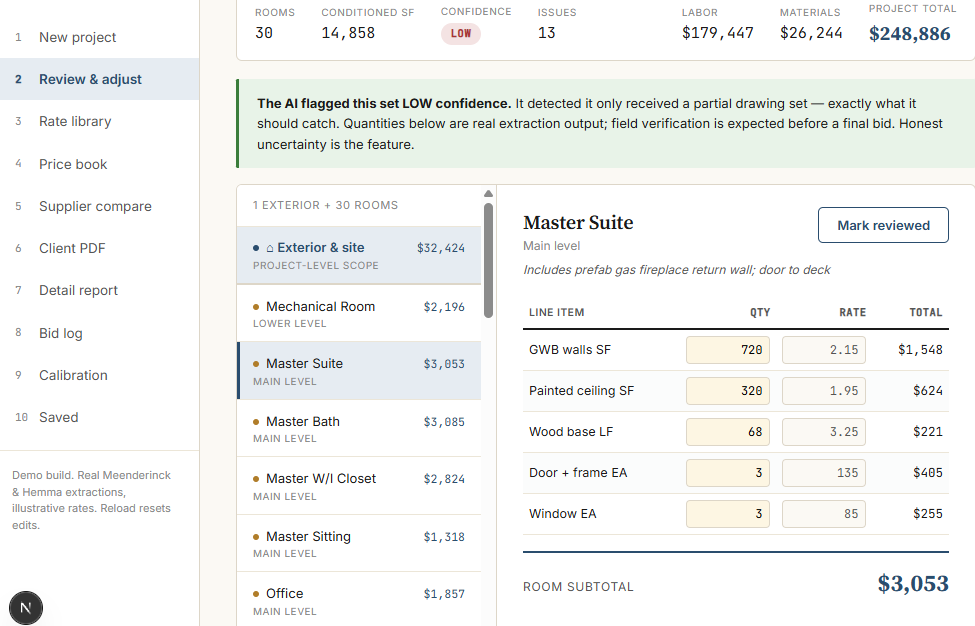
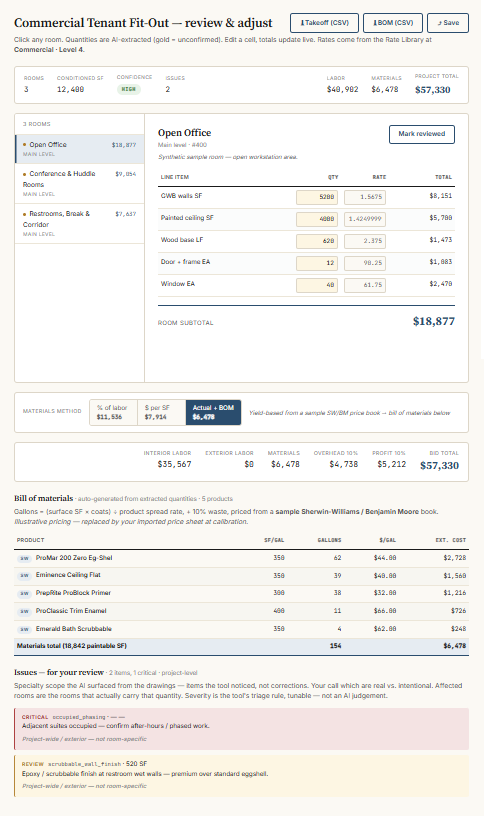
Measured against a bid he already won.
Speed is easy to demonstrate and worth very little on its own. Before this contractor relied on a single quantity, we ran it backwards: the system produced its own version of a job he had already priced and won, from the same drawings, without ever seeing his numbers. Then we compared line by line, with him judging every gap. His priced interior bid came back at 97.5%; the largest scope item was within about one percent of his own manual takeoff. That comparison is the reason he uses it — not the fifteen minutes.
A costing system built for one contractor.
Built around your pricing, not a template.
Your scope structure, your rates, your line items. Generic assemblies are where most estimating software starts fighting a contractor who has spent years developing how he prices work — so we start from yours instead.
Your estimator stays in charge.
Every quantity lands as a draft he approves, per room, with the source visible. He catches what the system gets wrong — and it does get things wrong, which is exactly why the output is structured so a person can check it. No staff displaced; the recovered time went to more bids.
We prove it before you commit.
The first real conversation is a comparison against a job you already priced. If we can’t reproduce a number you already trust, we say so and we don’t propose — which is a policy we publish because it costs us something.
Straight answer on fit: if your bids are mostly small repaints priced from a walkthrough, this is not your bottleneck and we’d rather tell you that now. This earns its keep where drawing sets are large, the work repeats, and a takeoff delay is costing you bids — high-end residential, commercial interiors, and repaint programs at scale. If you want software you can buy and start using this week instead, we wrote an honest comparison of the products in this category, including where they beat us.
Questions painting contractors ask
How accurate is AI takeoff for painting work?
On the engagement above: 97.5% reproduction of the estimator’s own completed, priced interior bid, with the largest scope item within about 1% of his manual takeoff. Read that honestly — 97.5% means 2.5% did not reproduce, which on a large residential interior is real money, and it is why the estimator approves every line. The full method and its limits are in the benchmark article.
Can it read a full architectural set?
Yes — 47 pages for a roughly 37,000 sq ft residence, producing per-room quantities in under 15 minutes. Where a set is ambiguous or the elevations disagree with the finish schedule, the system surfaces the conflict rather than quietly picking one. That still lands on a person’s desk, which is correct.
Do I have to change how I price?
No — that’s the point of building it around your structure. Your scope items, your rates, your line names. The output is supposed to look like something your estimator already recognizes, because a number he has to translate is a number he can’t check quickly.
What happens to my estimator?
He runs it. In this engagement no staff were displaced; what changed is that takeoff stopped being a five-to-seven-day external dependency, so estimating capacity went into more bids rather than fewer people. He is also the ground truth the whole thing is measured against — the accuracy figures on this page exist because of his manual work, not instead of it.
What do I need to bring to the first conversation?
One job you already priced and won, and the drawings it came from. We run it blind and put our number next to yours, line by line. It takes 30 to 45 minutes and you leave with the comparison whether or not we passed.
Bring a bid you already won.
Send the drawings it came from and we’ll run the takeoff blind, then show you our numbers against yours line by line. If we can’t reproduce a bid you already trust, we’ll tell you and we won’t propose.

Practical AI for small and mid-sized business. Live products, verified numbers, and your experts in charge of every decision.