Quoting automation: the parts that work, and the part that bites.
Almost nobody actually wants an automated quote. What they want is the quote out the door today instead of Thursday, without guessing at the number. Those are different problems, and only some of them should be handed to a machine. Here is the split, including the layer we think should never be automated — and what goes wrong in the firms that automate it anyway.
sending, follow-up
fast, and then checked
the one that costs you money
Quoting is not one job. It is three, and they have different answers.
Assembly — automate it completely.
Turning an approved set of numbers into a document, in your format, with your terms, sent and then chased. There is no judgement in any of that. If a person on your team is still copying figures into a template and remembering to follow up on Friday, that is pure recoverable time and almost any quoting tool will take it off you.
Measurement — assist, then check.
Counting rooms off a drawing set, measuring areas, pulling quantities division by division, reconciling what the elevations say against what the schedule says. This is the part that eats the week, and it is where AI genuinely earns its keep — as long as the output is shaped so a person can check it quickly, and someone actually does.
Pricing judgement — never.
What the site conditions are really like. Whether this client pays on time. Who else is bidding and how hungry they are. Which risk you are willing to carry and what you charge to carry it. None of that is in the drawings, and a system that produces a confident price without it is not saving you a day — it is quietly putting your margin at risk on every job.
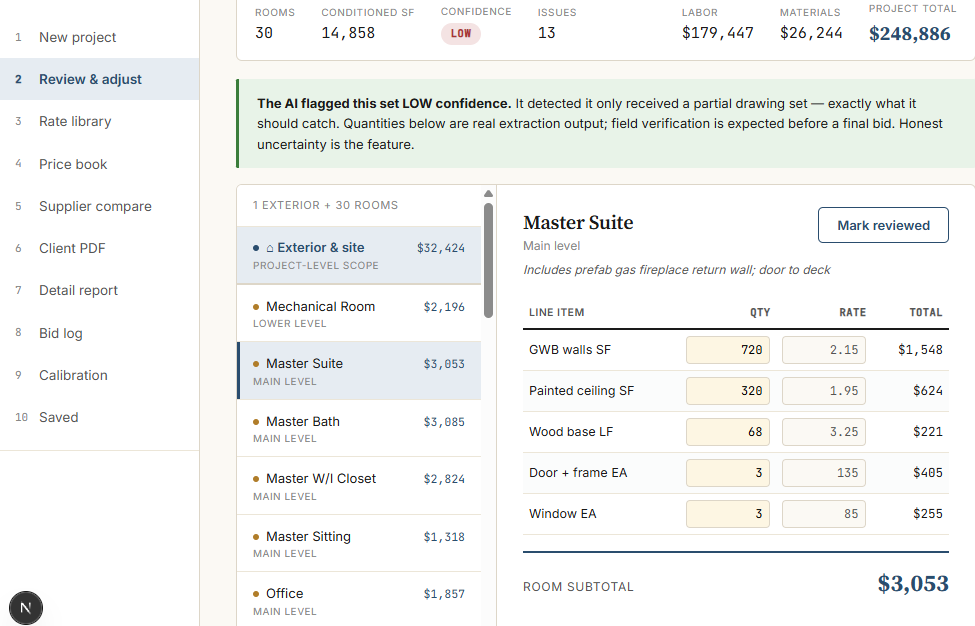
A wrong number, delivered beautifully.
The failure mode of quoting automation is not that it breaks. It is that it works, and produces a number nobody checked. Price a job low and you win it and lose money on it for six months. Price it high and you never find out why the phone stopped ringing. Both look identical from the inside — a fast, clean, confident quote — and by the time the pattern is visible it is several jobs deep. That is the whole reason we say it this way: never confuse the machine being impressive with the machine being right.
Speed on the measuring. A person on the price.
We build the middle layer, and we prove it before anyone relies on it. For a high-end residential painting contractor, a 47-page architectural set became per-room takeoff quantities in under 15 minutes — work that had been a five-to-seven day outsourced wait. For a commercial general contractor, a plan set became a priced budget across all 21 CSI divisions in under two minutes. In both cases the estimator approves every line, and in both cases no staff were displaced. The speed is not the claim. The check is.
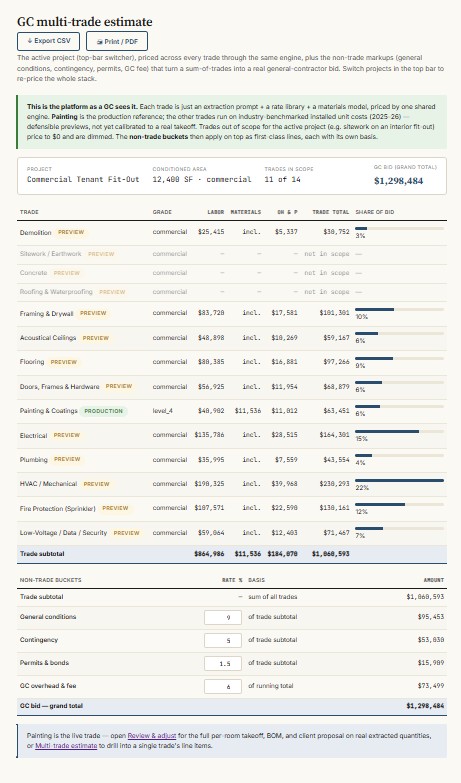
Both systems had to reproduce a number the contractor already trusted.
bid, reproduced blind from the drawings
his own manual takeoff
sealed bids across six projects, on the calibrated sector
Read those honestly. 97.5% means 2.5% did not reproduce, which on a large residential interior is real money — and an aggregate variance is not a promise about any single division. That is precisely why a person signs off every line, and why the first conversation is a comparison against work you have already priced rather than a demo. The method is written out in full at the Mirror Test.
Straight answer on fit: if what you need is a button that turns approved numbers into a sent PDF and chases it on Friday, you do not need us — you need a quoting tool, most of them do that well, and it will cost you a fraction of what a built system does. Buy one. This is worth having when the bottleneck is upstream of the document: large drawing sets, repeating scope, and a takeoff delay that is costing you bids. If you are weighing the products in this category, we wrote an honest comparison that includes where each of them beats us.
Questions contractors ask about quoting automation
Can contractor quoting be fully automated?
Parts of it, safely. Document assembly, formatting, sending and follow-up have no judgement in them and should be automated outright. Measurement and quantity extraction can be AI-assisted and then checked. The pricing judgement — risk, site conditions, who else is bidding, what this client is like to work for — should not be, because none of it is in the drawings. A system that prices without it is not faster; it is wrong faster.
What is the difference between quoting automation and AI takeoff?
Takeoff is the measuring: how much wall, how many fixtures, what quantities the drawings imply. Quoting is everything after that — applying rates, adding markup and risk, and producing the document. Most tools sold as “quoting automation” automate the document. The week you are actually losing is usually in the takeoff. How accurate AI takeoff really is covers the measuring side in detail.
How do I know an automated number is right?
Make it reproduce one you already have. Take a job you have completed and priced, run the system against the same drawings without showing it your figures, and compare line by line. If it cannot hand back a number you already trust, it has not earned a number you don’t. We call that the Mirror Test and we run it before proposing anything — it is also the cheapest possible way to evaluate any vendor in this category, including the ones that aren’t us.
Will automating quoting let me cut estimating staff?
That is not what happened in either engagement on this page, and it is not what we sell. In both cases no staff were displaced; the recovered time went into bidding more work. It is also worth noticing the circularity in the alternative: your estimator is the ground truth the system is measured against. Remove him and you have removed the only thing that can tell you whether the machine is still right.
What is the fastest safe way to speed up quoting?
In order, and the first one is free: stop hand-assembling documents. Then attack the takeoff, because that is where the days are. Then leave the pricing judgement alone. Firms that do those three in that order get most of the speed with none of the exposure — and firms that start at the pricing end are the ones this page is a warning about.
Bring a quote you already sent.
Send the drawings behind it and we’ll rebuild the takeoff blind, then put our numbers next to yours. If we can’t reproduce a quote you already trust, we’ll tell you and we won’t propose.
Commercial contractors
The vertical page: a plan set to a priced budget across all 21 CSI divisions in under two minutes, checked at −0.2% against six of the estimator’s own sealed bids.
Painting contractors
A 47-page set to per-room quantities in under 15 minutes, and 97.5% reproduction of the estimator’s own priced bid.
The Mirror Test
Before you trust a system with a number you don’t have, it has to reproduce one you do. The method in full.

Practical AI for small and mid-sized business. Live products, verified numbers, and your experts in charge of every decision.