A full line-item budget, before the meeting ends.
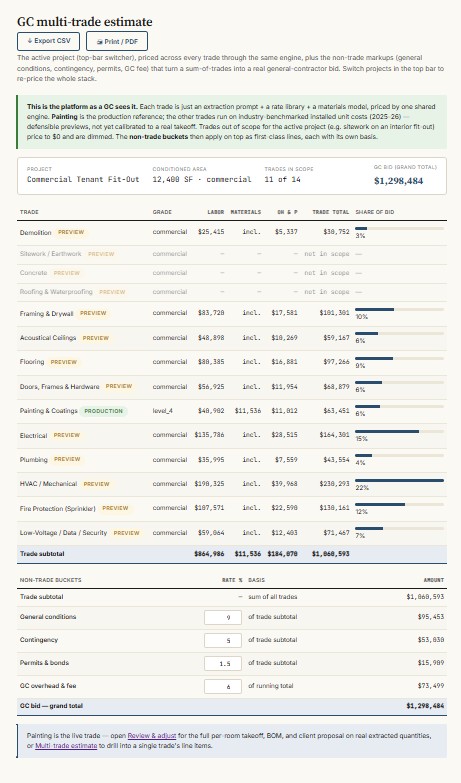
We built a Mid-Atlantic commercial general contractor an estimating platform that reads a set of floor plans and returns a priced, line-item construction budget across all 21 CSI divisions — in under two minutes, in the estimator’s own bid-sheet format. Then we checked it against six sealed bids he had already submitted. He approves every line. Nobody was replaced.
a senior estimator most of a day
on every run
six real projects, on the calibrated sector
The number a client wants on the first call.
Conceptual estimating is where commercial work is won and lost. An owner or a developer asks what a building will cost while the idea is still warm, and the honest answer takes a senior estimator most of a day — pulling quantities off the plans, pricing them division by division, and assembling something defensible. So the answer either arrives late, or it arrives fast as a number somebody made up. One loses the job; the other loses the margin.
Checked against six bids he had already sealed.
Speed is easy to show and worth nothing on its own. Before this contractor priced a single live job with it, we ran the platform backwards: it produced its own budget for six projects he had already bid and sealed, from the same drawings, without seeing his numbers. Then we compared division by division, with him judging every gap. The aggregate came in at −0.2% against his own bids on the sector it was calibrated for. That comparison is why he uses it — not the two minutes.
An estimating platform built around one contractor's numbers.
Two modes, and the difference is labelled.
A detailed, line-item proposal for work you are actually bidding — and a clearly-marked feasibility band for the early conversation, where a false precision would be worse than a range. The system never presents one as the other, which is a design decision, not a setting.
Priced from your rate tables, not a national average.
The rates come out of your own historical jobs and your own subs. That is what makes the variance figure mean anything — and it is also why the calibration is sector-specific rather than a claim about all commercial construction.
Your estimator stays the last word.
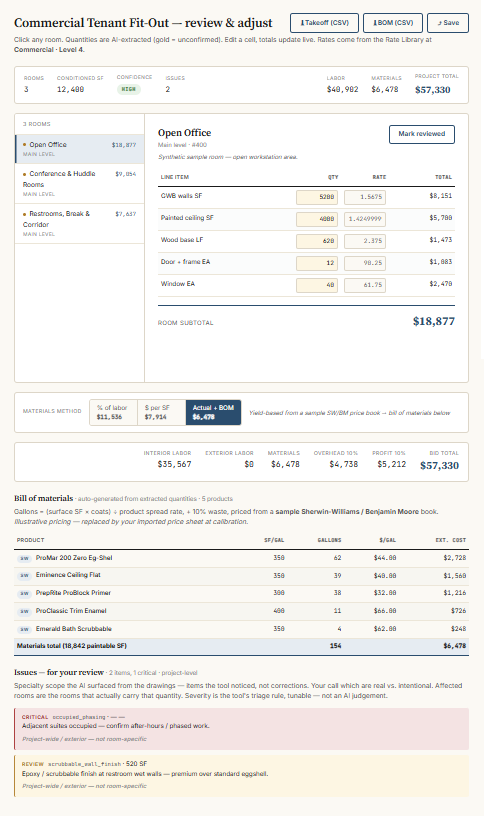
Every division lands as a draft he approves, with the source visible. He catches what the system gets wrong, and it does get things wrong — which is exactly why the output is shaped so a person can check it quickly. No staff displaced; the recovered hours went into more bids.
Straight answer on fit: if you self-perform one trade and bid off a takeoff you already do in an afternoon, this is not your bottleneck and we would rather say so now. This earns its keep where you are pricing whole buildings across many divisions, where conceptual estimates are a real part of how work is won, and where the rate history to calibrate against actually exists — without your own priced job history there is nothing to check the system against, and a number nobody has checked is exactly what we are arguing against. If you want a tool you can buy and start using this week instead, our honest comparison of the products in this category covers them, including where they beat us.
Questions commercial contractors ask
How accurate is an AI-generated construction budget?
On the engagement above: −0.2% aggregate variance against the estimator’s own sealed bids across six real projects, on the sector the rate tables were calibrated for. Read that qualifier as seriously as the number — an aggregate is not a promise about any single division, and a system calibrated on one sector has not been tested on another. That is why the estimator approves every line, and why the first thing we do with a new contractor is run the same comparison against their bids, not ours. The method is written out at the Mirror Test.
Does it price all 21 CSI divisions?
Yes — every run returns all 21, priced from rate tables built out of your own historical jobs and subcontractor pricing rather than a national average. Divisions where the drawings are thin come back flagged rather than quietly guessed, because a confident wrong number in Division 23 is more expensive than an obvious gap.
What is the difference between the two modes?
One is a detailed line-item proposal for a job you are bidding. The other is a feasibility band for the first conversation with an owner, labelled as a band so nobody mistakes it for a bid. Presenting an early-stage estimate with false precision is how contractors get held to numbers they never meant as commitments.
How fast is it, really?
Under two minutes from the plan set to a first-pass line-item budget — work that took a senior estimator the better part of a day. The two minutes is the least interesting fact on this page. It only matters because the budget it produces survived comparison with six bids he had already sealed.
What happens to my estimating team?
They run it, and they are the reason the accuracy figure exists — it is measured against their manual work, not instead of it. In this engagement no staff were displaced. What changed is that conceptual estimates stopped costing a day each, so the same team bid more work.
What do I need to bring to the first conversation?
One or two projects you have already bid and sealed, and the drawings they came from. We run them blind and put our budget next to yours, division by division. It takes 30 to 45 minutes, and you keep the comparison whether or not we passed it.
Bring a bid you already sealed.
Send the drawings it came from and we’ll build the budget blind, then put our divisions next to yours. If we can’t reproduce a number you already trust, we’ll tell you and we won’t propose.
The commercial case study
The engagement in full — 21 CSI divisions, two modes, and the variance measured against six sealed bids.
Thinking about quoting automation?
Which parts of quoting can honestly be automated, which need a person, and the failure mode nobody warns you about.
Costing
The product page: what we build, how it is verified, and who it is actually for.

Practical AI for small and mid-sized business. Live products, verified numbers, and your experts in charge of every decision.